
Last Updated: April 8, 2026

Last Updated: April 8, 2026
📋 Quick Answer — What Changed in the 2025 Dietary Guidelines?
The 2025-2030 Dietary Guidelines for Americans, released January 7, 2026, reversed 45 years of federal nutrition advice. Key changes:
- Protein is now the priority at every meal — including red meat and eggs
- Full-fat dairy is recommended, not low-fat
- Highly processed food is explicitly told to be avoided — not just limited
- No amount of added sugar is considered part of a healthy diet
- The food pyramid has been literally flipped — protein at the base, grains at the tip
This is the most significant reset in federal nutrition history. It got almost no media coverage.
Have you been doing everything "right" with food your whole life... and still watching your body go the wrong direction anyway?
What if the guidelines you followed weren't just ineffective... but were actually part of the reason things went sideways?
In this article, we're going to walk through the history of the Dietary Guidelines for Americans, what just got overhauled in the brand new 2025-2030 edition released in January 2026, and what all of it actually means for someone in your shoes. I've read the full DGA document, compared it to prior editions, and tracked how this policy has evolved over the last 45 years. This is my honest take.
By the end, you'll understand why this is being called the most significant reset in federal nutrition history, why it's getting way less attention than it deserves, and why I've been waiting for something like this for a very long time.
Quick note before we get into it: I'm not a doctor. I'm someone who spent 25 years being managed by the system this article is about. Everything I share here comes from my own experience and a lot of personal research. I support this shift because I've lived on the wrong side of these guidelines for most of my adult life. Take it as that, and talk to your doctor before making any changes. Now, let's go.
What Are the Dietary Guidelines for Americans, and Why Should You Care?
Most people think of dietary guidelines the way they think of a pamphlet in a waiting room. Official. Forgettable. Someone else's problem.
They're not.
The Dietary Guidelines for Americans are the instruction manual for how this entire country thinks about food. They control what your kids are served in school. What's served in military mess halls and veteran care facilities. What is served to patients in hospitals. What WIC provides to mothers and young children. What feeding programs serve to the elderly. What every dietitian in America is trained on. What your doctor learned in medical school about food.
The guidelines reach into everything. And for 45 years, they've been telling essentially the same story: eat more grains, fear the fat, choose lean, build your plate around carbohydrates.
Then on January 7, 2026, that story changed.
History of the Dietary Guidelines for Americans (1977–2025)
The official Dietary Guidelines for Americans launched in 1980, but the thinking behind them started in 1977 with a government report called "Dietary Goals for the United States." The McGovern Commission linked fat, especially saturated fat, to heart disease and told Americans to eat more carbohydrates, less fat, and to choose lean meats.
The science was contested. Experts disagreed. Some felt the report was rushed. It didn't matter. The pattern was set.
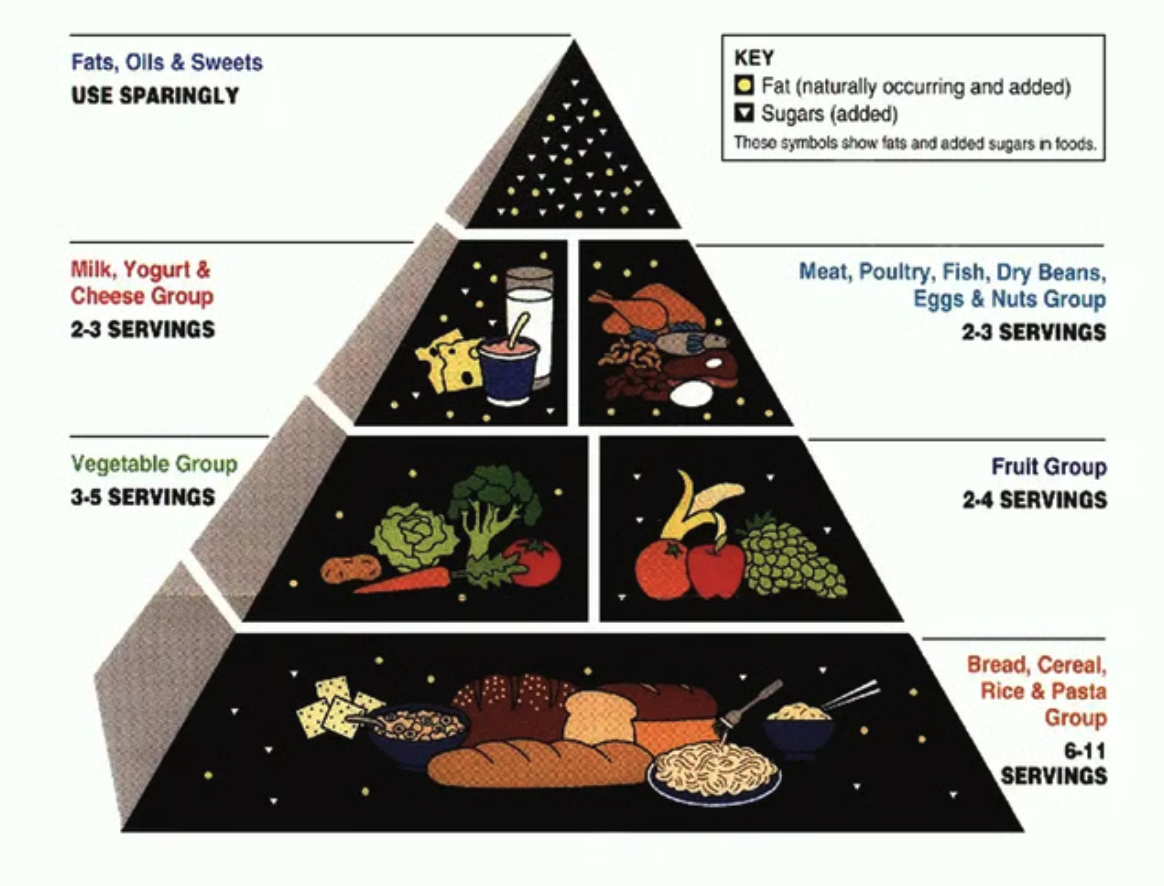
By 1980, the USDA and Department of Health and Human Services were publishing official guidelines every five years. The core message: avoid fat, avoid cholesterol, eat plenty of grains. In 1992, the Food Pyramid made it visual. Bread, cereal, rice, and pasta at the foundation, 6 to 11 servings a day. Fat at the very top, to be used "sparingly."
That pyramid ended up on cereal boxes, in school textbooks, and in every cafeteria in America for decades.
Now, I want to be careful here. Correlation is not causation, and I'm not going to tell you the guidelines single-handedly caused the obesity crisis. But I will share this:
According to CDC data, more than 73% of American adults were overweight or obese as of 2017-2018. The DGA's own introduction puts the current number at more than 70%. And a 2025 CDC analysis found that nearly 1 in 3 American adolescents between ages 12 and 17 now has prediabetes. (Note: the CDC updated their methodology with this figure, and some researchers have asked for more transparency about the calculation. But even the older methodology pointed to roughly 1 in 5 teens. Either way, it's not good.)
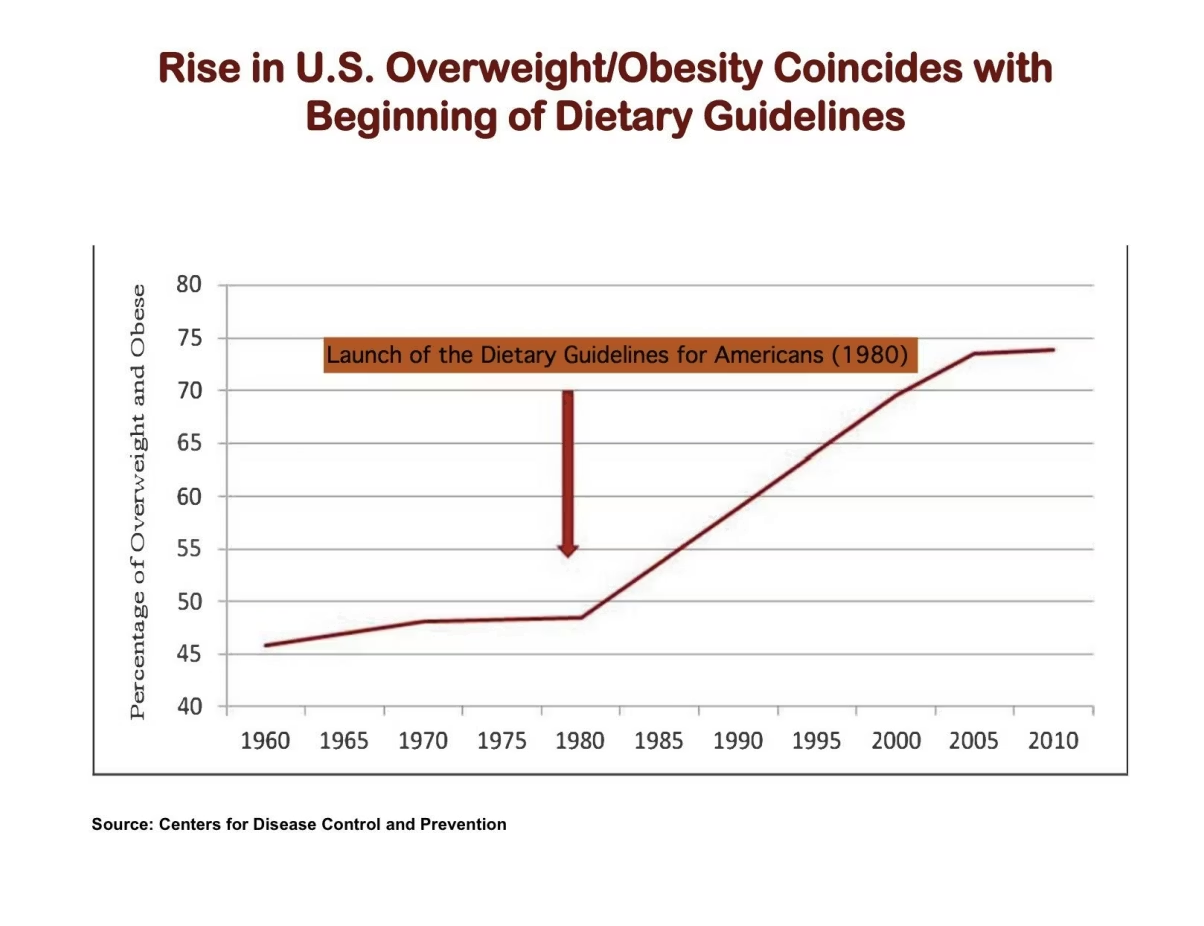
90% of all U.S. healthcare spending goes toward treating people with chronic disease, according to the CDC. Whatever we've been doing for the last 45 years, it hasn't been working.
The guidelines evolved over the decades. The pyramid became MyPlate in 2011. But the core message stayed intact: eat your grains, limit fat, keep saturated fat under 10%.
Until now.
I Wasn't Always the "Good Patient." And That Might Be the Most Honest Part of This Story.
Here's where this gets personal, and I want to be real with you.
I was diagnosed with Type 2 diabetes at age 22. And in the beginning, yeah, I was the good patient. I showed up. I followed the plan. I did what I was told.
But here's what happens when you do everything right and nothing gets better. You stop trusting the advice. Not all at once. Gradually. You keep taking the medications because what else are you going to do... but you start to tune out the lectures about what to eat. Because you've been eating that way, and your labs are still trending in the wrong direction. So what's the point?
And then something subtle happens that I think a lot of people with chronic conditions understand, but nobody talks about: the medications become a shield.
I could eat the whole pizza. I could have the ice cream. I was on insulin. I'd just adjust the dose. That's literally what insulin does, right? It manages the blood sugar spike from whatever you just ate.
Except... no. That's not right at all. That's managing a symptom while the disease gets worse underneath. Every year. For 26 years.
Was I being stupid? Probably, at least part of the time. Was I getting the kind of tough love from the medical system that might have actually changed my trajectory? Looking back, no. Nobody ever told me my T2D could be reversed. That word "remission" was never once mentioned. What I heard, over and over, was "manage." Take this medication. Add this one. Adjust the dose. Come back in three months.
I was the obedient patient on paper. I was on five medications, including 52 units of insulin a day. I showed up for my appointments. And all the while I was developing nerve damage in my hands and feet, having laser surgery in my eyes due to diabetic retinopathy, getting needles in my eyeballs multiple times a year (that one still going, by the way), dealing with frozen shoulders and trigger fingers, depression, brain fog, fatigue, and more.
All of that happened while being "managed."
Honestly, it still pisses me off. Not at my doctors. They were following the same guidelines everyone was following. But at the idea that medication management and dietary guidelines built on questionable science kept me from the truth for 26 years.
The thing that finally snapped me out of it wasn't a single moment, it was a sequence. I'd already been doing some early research, poking around the work of Dr. Jason Fung and the science around how food actually affects metabolism, specifically diabetes. The ideas were starting to land. But awareness and action are two different things.
Then, on April 17th, 2020, a heart surgeon looked me in the eye and basically told me to change course or end up on his operating table. That was the line in the sand. That was the wake-up call the system never gave me, because it took a surgeon to say the quiet part out loud. The very next day, my health journey started for real.
I changed what I ate. I stopped eating the way the pyramid told me to. And things actually changed. I lost 80 pounds in 11 months. Dropped all five medications, including the insulin. In March of 2021, my doctor used the word "remission" for the first time in 27 years. (The full story of that journey is coming in a separate post. Stay tuned.)
XL to medium. 36-inch waist to 28. I had to happily rebuild my wardrobe, including my entire Mickey Mouse tee shirt collection from scratch, because every single one I'd had for years was suddenly swimming on me.
I tell you that not to brag. I tell you that because it is the context through which I've been watching the DGA story unfold. So when the government does a full 180... I notice.
What the 2025-2030 Dietary Guidelines Actually Say
Released January 7, 2026, and published at realfood.gov, the new Dietary Guidelines for Americans come in at 10 total pages. The previous edition ran over 160. The message got a lot simpler.
The message: Eat real food.
Here's what actually changed.
Protein Is Now the Priority, Not the Problem
If you've spent years being told to swap the steak for chicken breast, skip the egg yolk, and treat red meat like an occasional guilty pleasure... this section is for you.
The new guidelines explicitly say to prioritize high-quality, nutrient-dense protein foods at every meal. That includes red meat. Eggs. Poultry. Seafood. Real animal foods are no longer the villain. They are the foundation. The serving goal in the DGA document is 1.2 to 1.6 grams of protein per kilogram of body weight per day.
Full-Fat Dairy Is Back
Remember grabbing the skim milk because the label said it was the "heart healthy" choice? Or reaching for low-fat yogurt at the office because it felt like the responsible option?
When consuming dairy, the guidelines now say to include full-fat dairy with no added sugars, describing it as an excellent source of protein, healthy fats, vitamins, and minerals. This is not the same government that told you to reach for the low-fat option for 40 years.
Highly Processed Food Is Named and Called Out
Think about what you've grabbed from the airport, the conference buffet, or the vending machine in a pinch. The "heart healthy" granola bar. The low-fat crackers. The protein bar with 30 ingredients you can't pronounce. That's the stuff being called out here by name.
For the first time in the history of these guidelines, the DGA specifically says to avoid highly processed packaged foods. Not limit. Avoid. The guidelines document also explicitly calls out "petroleum-based dyes," artificial flavors, and chemical additives as things to limit. The Standard American Diet has been put on notice in the official federal guidelines.
Added Sugar Gets a Hard Line
No amount of added sugar is recommended or considered part of a healthy diet. That's a direct quote from the DGA document. For children, the guidelines say avoid added sugar entirely until age 10. The previous guidance said until age 2. This is a much sharper stance, long overdue.
The Visual Got Flipped. Literally.
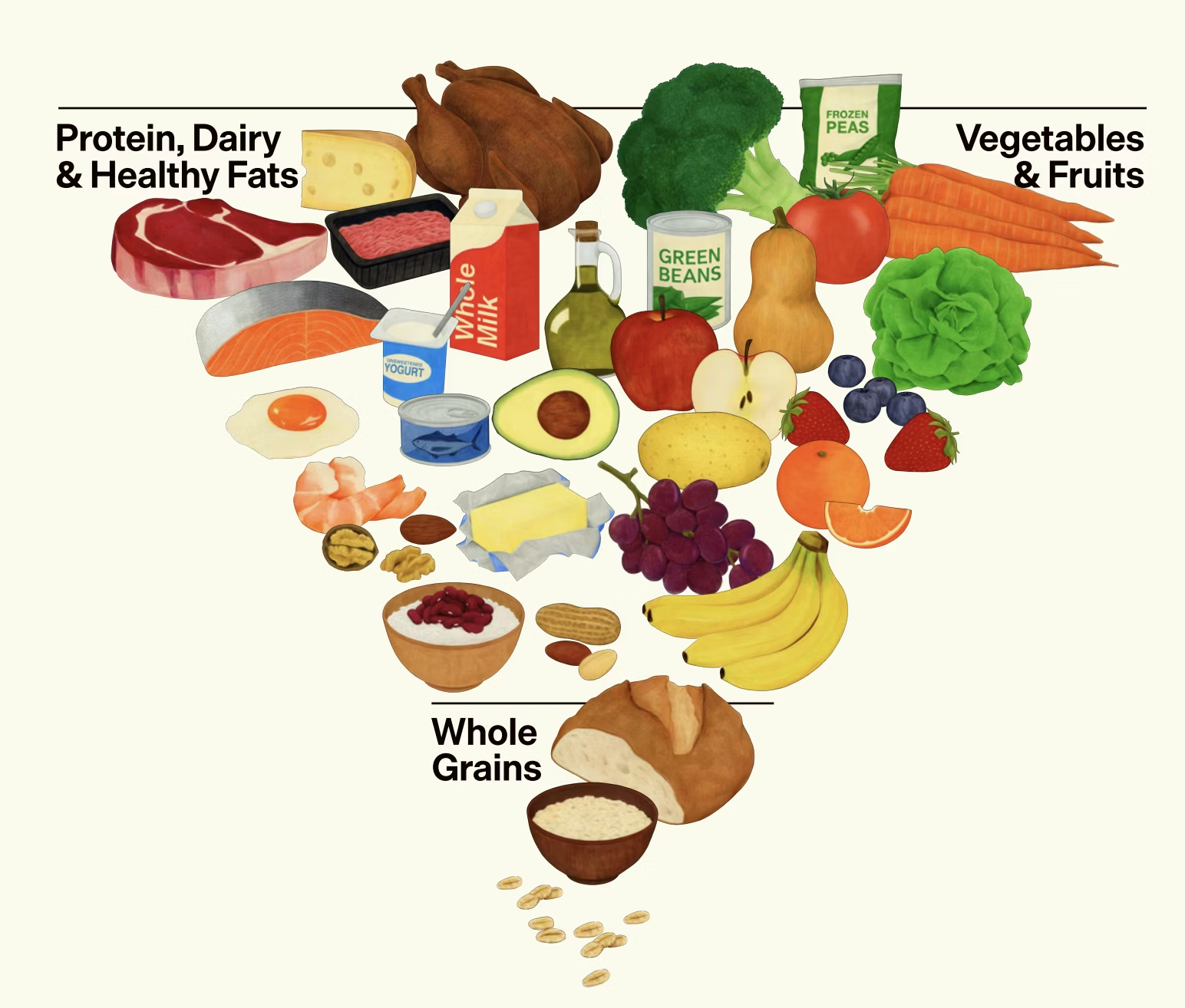
The old food pyramid put grains at the bottom as the foundation. The new visual is an inverted pyramid. Protein, dairy, and healthy fats are at the wide end. Whole grains are at the narrow tip. That is not a subtle design update. That is a 180-degree reversal of what the government has been telling you to build your diet around for 45 years.
Criticisms of the 2025-2030 Dietary Guidelines
I want to be straight with you here, because that's the whole point.
The guidelines still list a 10% cap on saturated fat… the same limit since 1990. The problem is that if you eat the way they're now recommending, real meat, full-fat dairy, butter, and eggs, staying under 10% saturated fat is basically impossible. They've recommended foods that blow past that limit while keeping the limit in place. That reads like a political compromise nobody had the nerve to clean up.
And the guidelines also removed the specific numeric limits on alcohol, replacing them with a vague "consume less for better health." That's not guidance. That's a shrug.
Why Aren't the New Dietary Guidelines Getting More Media Coverage?
Here's something I want to name, because you may have noticed it too.
Since these guidelines dropped in early January 2026, I've seen more news coverage of the latest sponsored study for a GLP-1 drug than I've seen about this. A meaningful overhaul of 45 years of federal nutrition policy and the mainstream media largely moved on within days.
Why?
Partly because this is politically charged in a way that makes straightforward coverage difficult. The guidelines were shaped by the current administration, which bypassed the official Dietary Guidelines Advisory Committee, a panel of independent nutrition researchers who had spent years producing a detailed scientific report. That report was set aside. In its place, a supplemental scientific review was conducted by a group selected through a federal contracting process. Over 210 researchers, doctors, and dietitians have since signed a letter challenging the scientific basis of the new guidelines. The Physicians Committee for Responsible Medicine filed a formal petition to have the guidelines withdrawn.
Are some of these objections coming from people with their own industry ties and institutional loyalties? Yes. Are some of the objections legitimate? Also yes. That's the honest answer.
What I find more interesting, though, is the silence from parts of the medical and nutritional establishment that should, in theory, be thrilled to see "eat real food" as federal policy. Registered dietitians largely didn't rush to endorse this. Many nutritionists were publicly skeptical. And the pharmaceutical industry, whose bottom line depends in part on a population that manages chronic disease with medication indefinitely... well, they didn't say much either.
Man. Here it is. A set of guidelines that tells Americans to stop eating processed garbage and start eating real food, and the loudest response from the medical-industrial complex is a shrug and a letter of protest. I'll let you sit with that one.
What I will say is this: when the official guidelines of the United States government now say that individuals with certain chronic diseases, including type 2 diabetes, cardiovascular disease, and obesity, may experience improved health outcomes following a lower carbohydrate diet... that is a meaningful sentence. That sentence did not exist in any previous edition of these guidelines.
Is the new DGA perfect? No. Is it a significant step in the right direction? I think so. And it's worth paying attention to, whether the news cycle is or not.
What This Actually Means for You Right Now
Look, the guidelines are not a coaching program. They will not fix 20 years of metabolic damage on their own. And your doctor may not have read them yet.
But here's what's different today than it was two years ago: the idea that real food, protein, healthy fat, and dramatically less processed garbage should be the foundation of your diet is no longer a fringe position. It is the official position of the federal government.
If you've spent your 20s, 30s, 40s, or 50s doing everything your doctor said, eating lean and low-fat and whole grain, and you still feel like your body is working against you... you were not imagining it. You were not broken. You were not lazy.
You were following a broken playbook.
Here's something else the new guidelines still won't tell you, and this is important. These are population-level guidelines. By federal law, specifically the National Nutrition Monitoring and Related Research Act of 1990, the Dietary Guidelines are required to contain nutritional and dietary information for the general public. That's not my opinion, that's how the guidelines are designed. And the 2025-2030 Dietary Guidelines themselves make this clear. In the DGA document that runs just 9 pages of actual guidance, chronic disease gets a single section on the final page. It is not woven into the core guidance.
My opinion, based on my own experience and the work I do with people navigating metabolic challenges, is that these guidelines, if followed as is, may not be enough for someone whose metabolism is already broken, inflamed, or compromised by years of chronic disease.
If you have type 2 diabetes, metabolic syndrome, or significant insulin resistance, the guidelines are a meaningful step in the right direction. But they likely don't go far enough for you. A blanket recommendation of 2 fruit servings per day means nothing without context around sugar content, carbohydrate load, and glycemic impact. For someone managing blood sugar, fruit isn't just fruit. And while the guidelines do give protein intake ranges, there are no carbohydrate ranges anywhere in the DGA document. Not one. For someone who needs to turn that carbohydrate knob way down to actually heal, that omission matters.
The point isn't to criticize the Dietary Guidelines for Americans document that got a lot right. The point is that real food is the foundation, and for people dealing with metabolic disease, the nuance on top of that foundation is where the real work happens. How far down you need to take your carbohydrates depends on your individual situation. That's not something a 9-page federal guideline can tell you. It's something you have to work through with someone who understands what's actually going on in your body. (More on this in a future post.)
That doesn't undo the damage. But it does change the conversation. And if it means the next generation of doctors, dietitians, and school lunch programs starts from a different foundation, that matters.
For you, reading this today, it means one thing: you now have federal permission to eat the way humans have actually eaten for thousands of years.
Use it.
What's Next
If this raised more questions than it answered, good. That means you're paying attention.
The full story of my personal journey is coming in a separate post, discussing what 26 years of being "managed" actually looked like, what the wake-up calls were, and exactly what I changed. I'll link it here when it's live.
In the meantime, if you're a business owner or executive who's tired of managing your health instead of reclaiming it, I work one-on-one with people who are done pushing it to "next quarter." Book a free clarity call, and let's figure out what's actually going on.
Want to read the actual guidelines yourself? They're right here at realfood.gov.
Until next time,
Doc
Frequently Asked Questions
What are the biggest changes in the 2025-2030 Dietary Guidelines? Protein is now the priority, full-fat dairy is back, processed food is explicitly called out as something to avoid, no amount of added sugar is considered healthy, and the food pyramid has been literally inverted. It is the most significant reversal in 45 years of federal nutrition guidance.
Is the food pyramid still the official US nutrition guidance? The original grain-heavy pyramid was replaced by MyPlate in 2011. The 2025-2030 guidelines introduced a new inverted pyramid where protein and healthy fats form the base and grains sit at the narrow tip — a complete reversal of what Americans were taught for decades.
Do the 2025 Dietary Guidelines help people with Type 2 diabetes? More than any previous edition. For the first time, the guidelines acknowledge that a lower-carbohydrate diet may benefit people with Type 2 diabetes, cardiovascular disease, and obesity. That language is new. But the guidelines are population-level and may not go far enough for someone who needs specific carbohydrate reduction to manage active metabolic disease.
Why did the government change the dietary guidelines? Because the data was impossible to ignore. Over 70% of American adults are now overweight or obese. Nearly 1 in 3 adolescents has prediabetes. 90% of US healthcare spending goes to chronic disease management. The guidelines that were supposed to prevent this weren't working. The 2025 edition acknowledges that and changes course.
Disclaimer: I share what worked for me and what I've learned. I'm not a doctor. Talk to your doctor before making changes to your diet or health routine.